From executive business case to distributed team: building a knowledge management function without centralized funding
Twilio had over 10,000 employees and no centralized internal knowledge management function. Employees wasted significant time searching for information, asking colleagues questions that should have been documented, and recreating resources that already existed somewhere else. Often incorrectly.
But "knowledge management is important" wasn't going to get this function funded. I needed hard numbers to make the case.
I designed and ran an original survey across hundreds of Twilio employees to quantify the problem. The data showed that employees were spending measurable hours per week on knowledge-seeking activities that better systems would eliminate. I built a financial model that translated those hours into dollar costs, calculating annual waste in the millions depending on assumptions about average compensation and time spent.
From there I developed a ratio-based staffing model and presented multiple funding options at different investment levels, each with projected ROI. I built the full business case, defended it through the operating plan review process, and responded to real executive pushback on whether the investment was justified, whether existing tools could be repurposed, and whether the staffing model was right-sized. I addressed each concern with data from the survey and comparable benchmarks from industry research.
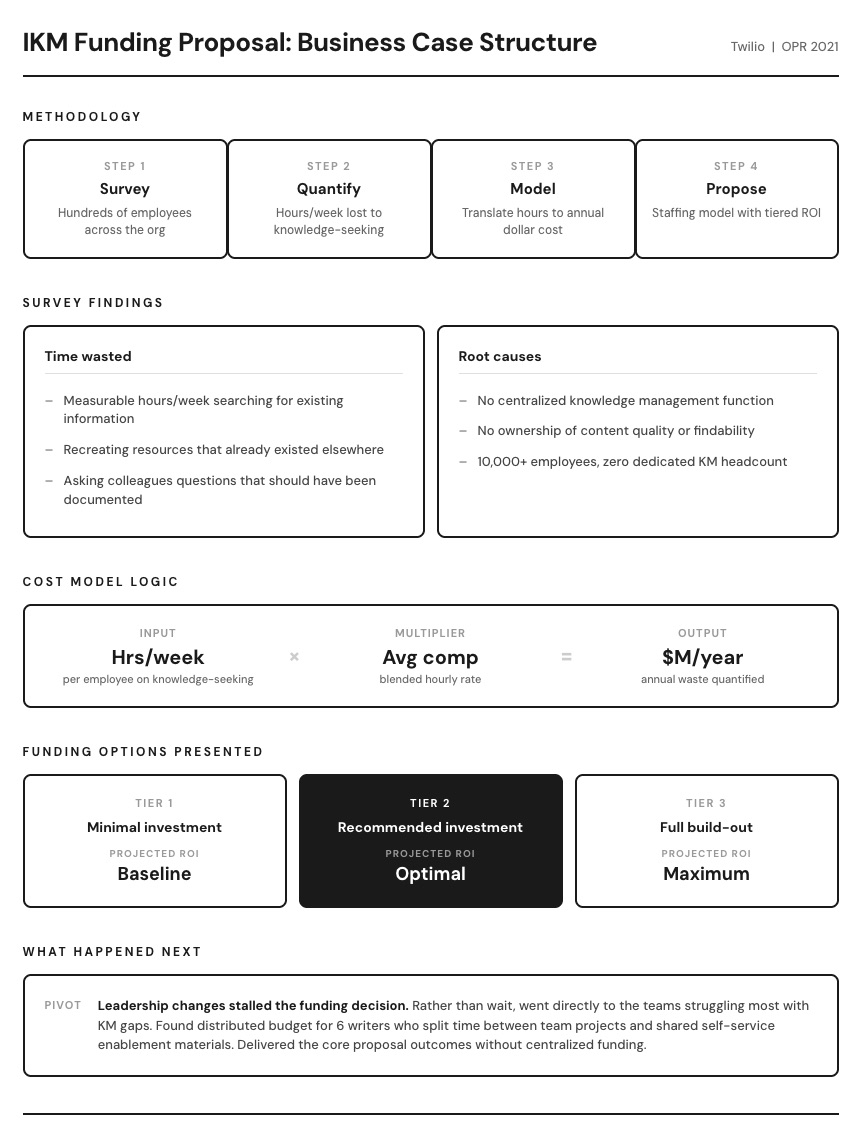
Leadership changes stalled the funding decision. Rather than wait, I pivoted. I went directly to the teams struggling most with knowledge management gaps and worked with each one to find budget for technical writers who would split time between that team's projects and building a shared library of self-service enablement materials for teams that couldn't afford a dedicated writer.
This was a deliberate choice to deliver results through a distributed model instead of holding out for centralized funding that might never come. It meant more coordination overhead and less structural authority, but it got writers into seats and content into production while the formal proposal sat in limbo.
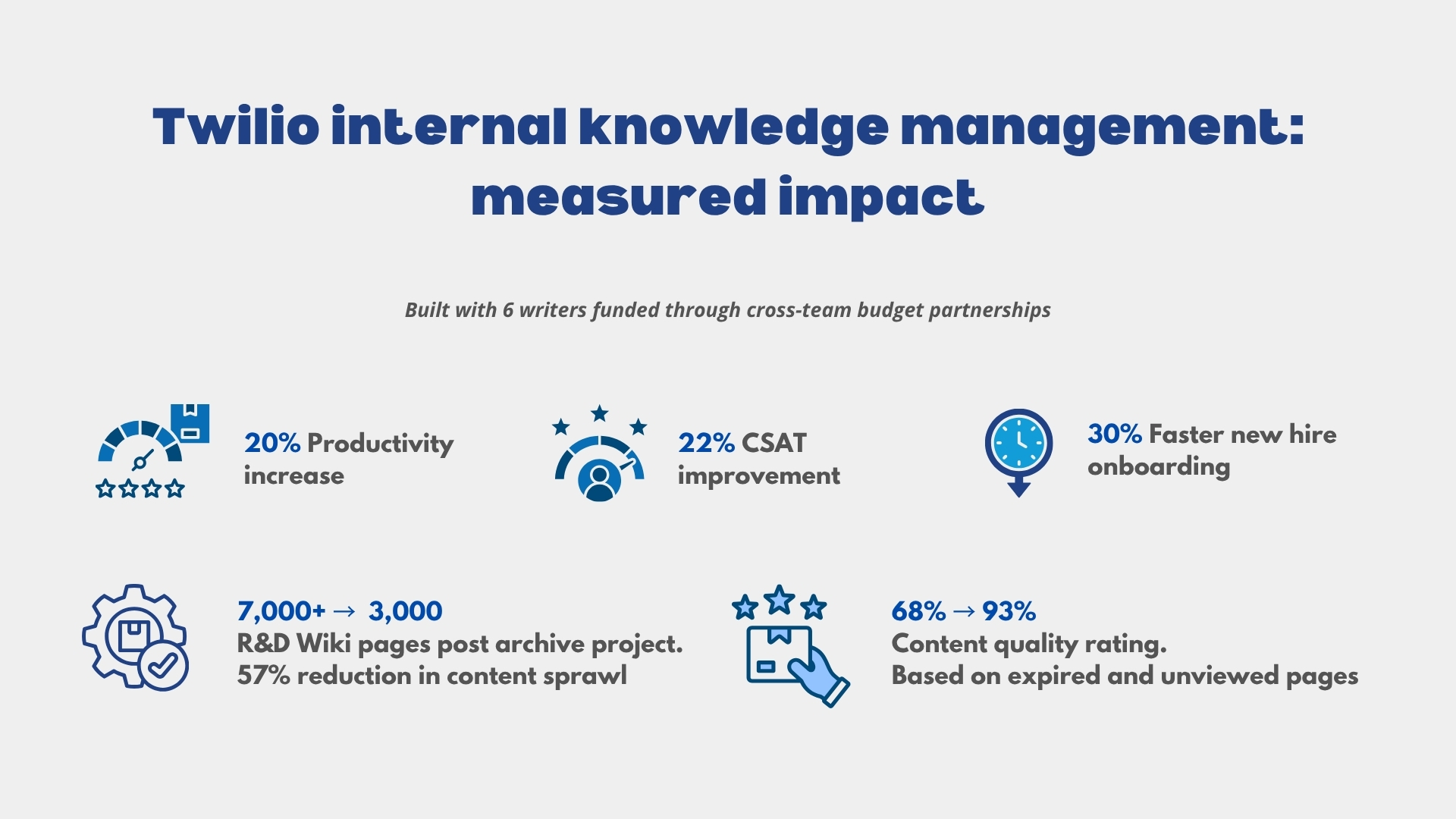
I hired and managed six writers through this distributed model and delivered much of what the original proposal called for, without centralized funding. Productivity increased 20%. Employee satisfaction scores improved 22%. New hire onboarding time decreased 30%.
We also completed an R&D wiki archiving project that cut page count from 7,000+ to just over 3,000 and raised content quality ratings from 68% to 93%. I then delivered maintenance guidelines so teams could sustain the improvements without ongoing central support.